If you’re considering a second nose surgery, revision rhinoplasty before-and-after photos are probably one of your most important research tools. They’re also easy to misread. A revision “before” photo shows a nose that has already had surgery, so a good result is judged differently than it would be after a first-time rhinoplasty.
Having performed more than 3,500 rhinoplasty and revision rhinoplasty procedures, I’ll explain what to look for in these photos so you can evaluate results in context and develop realistic expectations for your own surgery.
What Should You Look for in Revision Rhinoplasty Before-and-After Photos?
In before-and-after photos, look for consistent photo conditions, a clear explanation of the patient’s concerns after the previous surgery, and visible improvements that align with the goals of the revision.
- Matching conditions: The before-and-after photos should use the same angle, lighting, distance, and expression. A change in lighting alone can make a bridge look narrower or a tip look more refined than it is.
- A defined starting point: A useful case description identifies the concern, such as an over-projected tip, a residual hump, or nasal collapse. These details help you assess the improvements in the after photos.
- Realistic symmetry: The truth is, “real” noses aren’t perfectly symmetrical, and perfect symmetry isn’t achievable with a primary or revision rhinoplasty. Minor differences between sides in an after photo don’t signal a poor result. Instead, look for overall improvement and balance.
- Facial harmony: A revised nose should look like it belongs on the face and balances well with your other facial features.
The strongest revision results aren’t necessarily the most dramatic; they’re the ones that correct specific problems and look natural on the patient’s face.


This patient was bothered by a full nasal tip and a crooked columella after a prior rhinoplasty in Turkey. Dr. Gross performed a revision with bridge straightening, tip refinement, and nostril narrowing, leaving his nose much straighter from the front and correcting his drooping tip in profile.
What Problems Does Revision Rhinoplasty Correct?
Revision rhinoplasty can address cosmetic and functional concerns that remain or develop after a primary rhinoplasty (nose job), such as a collapsed or pinched nose, a residual hump, tip problems, asymmetry, and breathing difficulty.
- Over-resection: The most common problem I see is a first surgery that removed too much tissue and weakened the nose’s support. This can cause collapse, pinching, curvature, and breathing problems. In photos, a successful correction reflects restored strength and straightness, not necessarily a smaller nose.
- Under-resection: When the first surgery removed too little tissue, a hump or wide tip may remain. Since revision can further refine what’s there rather than rebuild it, the change tends to be more noticeable, such as a smoother profile or a slimmer tip.
- Tip problems: An over-projected, drooping, or pinched tip is a frequent reason for revision. Look closely at the gallery’s profile and base views, which show these corrections most clearly. If your main concern is the tip, read more about your options in my post on rhinoplasty tip revision and other ways to correct a botched nose job.
- Asymmetry and curvature: Refinements to a crooked or uneven nose are typically easiest to evaluate in the front and base views.


Three prior rhinoplasties left this patient with a shortened, over-rotated tip. Dr. Gross repaired the prior damage with complex grafting techniques and a dorsal implant, ultimately delivering the naturally balanced results she desired.
Revision rhinoplasty is more complex than primary surgery for several reasons, including scar tissue and thinned skin that can soften how sharply new contours show through. Revision results often look more subtle than first-time results, so it’s best to judge each case against its own starting point.
Which Photo Angles Matter Most in Revision Rhinoplasty Photos?
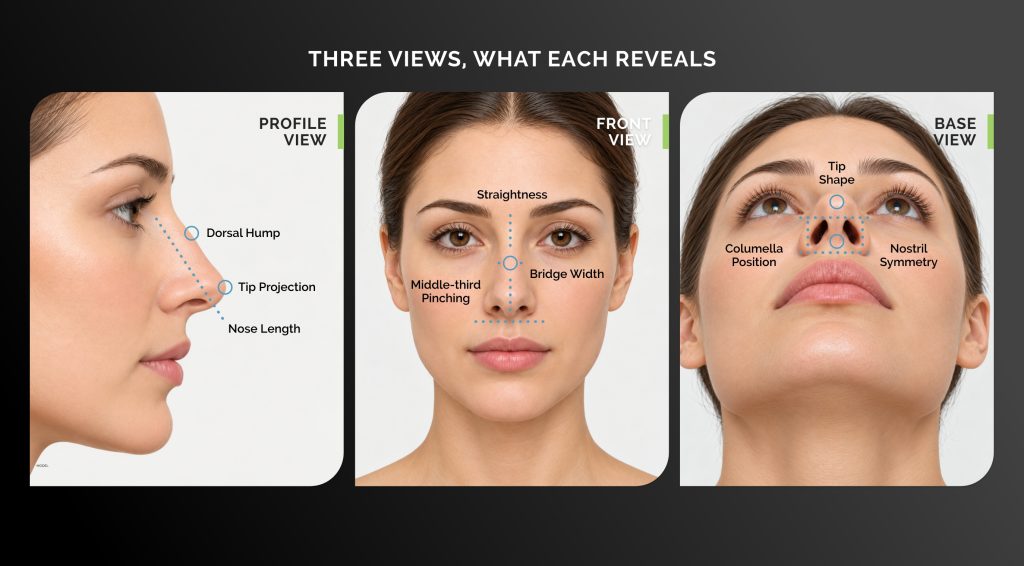
The profile, front, and base views each reveal different nasal features, so the most informative revision cases show the nose from multiple angles.
Profile
Shows the dorsal hump, tip projection, and nose length.

This patient’s tip appeared over-operated and over-projected from the side after a previous rhinoplasty. Reconstruction with tip de-projection and ear cartilage grafting improved both his appearance and breathing, as shown in his profile at 1 month.
Front
Shows straightness, bridge width, and any pinching in the middle third of the nose, called an inverted V deformity.

A previous rhinoplasty left this patient’s nose twisted and deviated to one side. Reconstructive rhinoplasty with tip refinement and osteotomies straightened the nose and improved breathing, as shown here 3 months after revision surgery.
Base
Shows nostril symmetry, tip shape, and whether the columella (the strip of tissue between the nostrils) sits straight and centered.

This close-up base view demonstrates how Dr. Gross addressed this patient’s nostril asymmetry and twisted tip without any visible scar using an open revision rhinoplasty approach.
How Long Does It Take To See Final Revision Rhinoplasty Results?
Final revision rhinoplasty results typically take a year or longer to fully develop because residual swelling, especially in the tip, resolves slowly after a second surgery.
A few things to keep in mind:
- Longer swelling: Swelling after revision can last longer than after a first rhinoplasty, partly because of existing scar tissue.
- Early photos: An after photo taken at 3 months shows progress, not the finished shape.
- Time frame: When reviewing before-and-after cases, check the description to see when the after photo was taken. Photos taken a year or more after surgery give the most accurate picture of the final result.

After major trauma and a prior nose surgery left this patient with deformity, scarring, and a deviated septum, Dr. Gross performed reconstructive rhinoplasty with cartilage grafting, a dorsal implant, and septal correction to restore his nose and improve his breathing. As you can see, 1 year after surgery, his results look natural, balanced, and have fully settled into place.
For more about what to expect during healing, read my revision rhinoplasty recovery guide.
What Can’t Before-and-After Photos Tell You?
Before-and-after photos can’t show how well you breathe, how the nose’s internal framework was rebuilt, or how the result will hold up over time.
- Breathing: Many revision patients come to me to address breathing problems alongside nasal aesthetics. In these cases, I also look for issues such as septal deformity or turbinate problems.
- Internal grafting: Revision often calls for spreader grafts to support the middle of the nose, columellar strut grafts to support the tip, and alar batten grafts to reinforce the nostril sidewalls. None of these are visible in a photo, but they determine whether the nose functions well and stays stable.

A soccer injury left this patient’s nose crooked, and her prior rhinoplasty worsened her breathing. Dr. Gross performed a revision with tip refinement, septal repositioning, bone spur removal, and cartilage grafting to help her breathe easier and feel more confident from every angle.
When breathing and appearance both need attention, I often perform a revision septorhinoplasty, which straightens the septum and reshapes the nose in a single surgery. A photo can show the new shape, but the improvements in breathing are something the patient experiences firsthand.
How Can You Tell If a Surgeon’s Revision Results Fit Your Goals?
Look for a portfolio of revision cases with concerns similar to yours, then discuss your goals with a facial plastic surgeon who can explain what may be achievable for your anatomy and how they would tailor the procedure to your needs.
- Similar starting points: Look for cases that share your specific concern, not just cases with dramatic transformations.
- Revision volume and training: Ask how often the surgeon performs revisions and what training they have in structural rhinoplasty. Revision makes up a large part of my practice, as I perform 30 to 40 revision cases each year. I am fellowship-trained and double board-certified (by the American Board of Facial Plastic and Reconstructive Surgery and the American Board of Otolaryngology-Head and Neck Surgery). Nationally recognized surgeons, including Dr. Paul Nassif, refer complex revision cases to me at Primera Plastic Surgery.
- A personalized preview: I use advanced computer imaging and Gunter diagrams in my rhinoplasty consultations, so patients can see a realistic projection of their results rather than relying solely on someone else’s photos.
- An honest recommendation: A good consultation sometimes ends with advice not to operate. When the risks of another surgery outweigh the likely benefits, I tell patients so, even though it’s a difficult conversation.
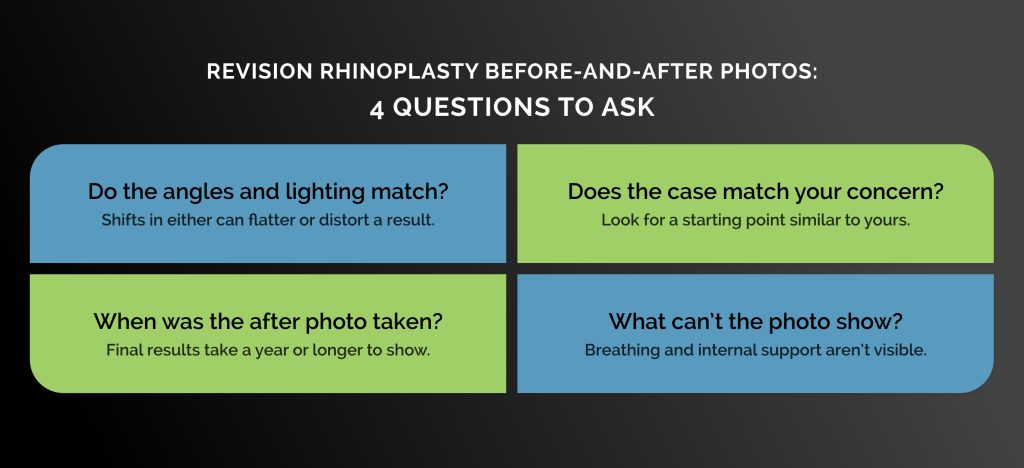
Finally, as you review rhinoplasty revision galleries, I encourage you to keep these 4 questions in mind:
Plan Your Revision Rhinoplasty Consultation
The most important qualities a patient can bring to revision surgery are patience, realistic expectations, and confidence in their choice of surgeon. A careful consultation helps ensure your safety and results. If you’re unhappy with a previous rhinoplasty, request a consultation at Primera Plastic Surgery in Lake Mary, serving Orlando and patients from throughout Florida, or call (407) 333-3040.
Leave a Reply