Revision rhinoplasty, also known as secondary nose surgery, is a specialized procedure to correct or improve the results of a previous rhinoplasty. Whether the first surgery didn’t meet your expectations or created functional issues such as breathing difficulties, revision rhinoplasty can restore both form and function.
Double board-certified facial plastic surgeon Dr. Edward Gross performs approximately 30 to 40 revision rhinoplasty procedures each year and has more than 30 years of experience treating complex nasal concerns after previous surgery. His advanced training includes an AAFPRS-sponsored fellowship at the Perkins Facial Plastic Surgery Center, with an emphasis on rhinoplasty and reconstructive rhinoplasty. Dr. Gross focuses on structurally rebuilding and supporting the nose with cartilage grafting to address aesthetic concerns and breathing problems.
Communities We Serve
Dr. Edward Gross provides individualized treatment to create balanced, natural-looking results for his revision rhinoplasty patients from the Orlando metro area and beyond, including:
“Many of my rhinoplasty patients come from throughout Florida seeking a skilled surgeon for revision procedures. Because revision rhinoplasty is complex, I focus on meticulous planning and technique to help each patient reach their goals.”
Case #552 | Orlando | Revision Rhinoplasty. This patient from Clermont, FL, had prior nose surgery with poor results. Her nose was twisted and deviated to the right. Dr. Gross performed a reconstructive rhinoplasty with tip plasty and osteotomies to correct and straighten her nose. Results shown at 3 months, and she is very happy. Her no... Read More
Case# 835. Ethnic Revision Rhinoplasty. This 35-year-old Hispanic man from Orlando previously underwent rhinoplasty at another location. He was left with a residual dorsal hump and a droopy nose tip. Dr. Gross performed revision revision rhinoplasty with structural tip rotation and removal of the dorsal hump. He is ver... Read More
Case #224 | Revision Rhinoplasty: She was bothered by the tip of her nose and wanted a younger appearance. Dr. Gross performed a rhinoplasty to refine her nose tip and a mini lift to tighten the jawline. Cartilage grafting was required to repair her nose from prior surgery.Location: Orlando, FL Read More
Revision Rhinoplasty | Orlando: This young woman was bothered by the overall size of her nose and thickness of the tip. Dr. Gross sculpted the tip with tip plasty and narrowed the nose bridge with osteotomies. Her nose is more refined and feminine. After photo shown at 6 months. Read More
Trina had a prior rhinoplasty in West Virginia and was left with an hour-glass deformity of the bridge. Notice the wideness of her bridge in her before photo. Dr. Gross consulted with her in our Orlando office and performed osteotomies during a Revision Rhinoplasty, which allow for narrowing of the bridge area. Her confidence was restored, an... Read More
Case #233 | Revision Rhinoplasty: This patient had 3 previous Rhinoplasties in Colombia and was left with a shortened, over-rotated tip. The tip of her nose was too short. She desired a longer nose that looked more natural. Dr. Gross repaired the damage to her nose in our Orlando surgery center using complex grafting techniques and a dorsal i... Read More
This Orlando, FL, patient previously had septoplasty surgery which caused asymmetry and deformity of her nose. She was also bothered by nasal breathing problems. Dr. Gross used cartilage grafting techniques and a Medpor ultra-thin implant to correct the deformities, straighten her profile, and improve the aesthetic balance of her nose. Her br... Read More
Case #815 | Revision Rhinoplasty | Orlando, FL: This 26-year-old woman was unhappy with the results from a previous rhinoplasty. She sought out Dr. Gross because of his expertise with revision rhinoplasties. Dr. Gross performed a cosmetic revision rhinoplasty with nostril narrowing, tip grafting, tip rotation, and tip straightening. Her nose... Read More
Keep in mind that each patient is unique and your results may vary.
Why Florida Patients Choose Us
Patients sometimes describe an unsatisfactory result from a previous rhinoplasty as a “botched nose job.” Correcting that result can be more complex than an initial rhinoplasty because the surgeon may need to work around scar tissue, altered anatomy, or weakened structural support.
Dr. Gross performs approximately 30 to 40 revision rhinoplasty procedures each year and has more than 30 years of experience with the grafting techniques these cases may require. Depending on a patient’s anatomy and concerns, he may use septal or ear cartilage, columellar strut grafts, alar batten grafts, or spreader grafts to rebuild support while addressing appearance and breathing.
His AAFPRS-sponsored fellowship at the Perkins Facial Plastic Surgery Center emphasized rhinoplasty and reconstructive rhinoplasty—training directly relevant when a previous procedure has altered the nose’s structure. If you’re considering revision rhinoplasty, request a consultation today or call our office at
(407) 333-3040.
“The doctors that refer patients to me do it because they know their patients will receive a very high level of professional care and excellent outcomes from a well-respected surgeon in the community—one with the most clinical experience in facial, plastic, and reconstructive surgery. It’s a momentum built over 30 years of cases and outcomes.”
Dr. Gross
How Much Does Revision Rhinoplasty Cost in the Orlando Area?
The cost of revision rhinoplasty at our practice near Orlando typically varies depending on your unique needs and goals. The overall cost is impacted by factors such as the type of procedure Dr. Gross performs, the extent of the revision needed, the use of possible ear cartilage grafts, or Enduragen acellular dermal grafts. Your consultation fee includes computer imaging, all follow-up treatments for 1 year, and photographs.
Many of our revision rhinoplasty patients choose to finance their procedure with flexible payment plans. As an example, let’s assume your procedure will cost $7,000, and you will make a $1,000 down payment. With a $1,000 down payment, you can get payments as low as $250/month with 24-month 0% interest financing. Contact CareCredit® to get exact offer details and options.
Most of these procedures are cosmetic, so insurance companies typically do not cover them. If you are seeking a functional revision rhinoplasty, check with your insurance provider about coverage and the process for seeking reimbursement for your surgical costs. Please note that Primera Plastic Surgery does not work with insurance companies. Read our post about insurance coverage for rhinoplasty to learn more.
Revision Rhinoplasty Videos
Proven Techniques, Outstanding Results
This procedure can fix both functional (related to breathing) and aesthetic (related to appearance) problems that occurred during a previous surgery, such as:
Under-resection (insufficient tissue removed)
Over-resection (excessive tissue removed)
Complications such as scarring, deviations, bumps, curvatures, collapse, and asymmetry
Breathing problems
Also, abnormal scarring is sometimes a problem after rhinoplasty or even revision rhinoplasty. Various terms have been used to describe these problems: “nose job nightmare” or “botched nose job.” Suffice it to say that for revisions or repairs, it is best to consult with a dedicated rhinoplasty specialist, such as Dr. Gross.
The best candidates for this procedure must have a BMI below 30. You can learn more about the signs you need revision rhinoplasty in our related blog post. Dr. Gross may also recommend using a product called Nose Perfect® if you’re experiencing swelling at the tip of your nose or have thick nasal skin.
Edward J. Gross, M.D.
Double Board-Certified Facial Plastic Surgeon
With more than 30 years of experience in facial plastic surgery, Dr. Gross has earned the confidence of patients and referring physicians through his commitment to personalized care and natural-looking results. His extensive experience, advanced training, and individualized approach help patients feel informed and supported throughout their treatment.
Revision Rhinoplasty With a Facial Plastic Surgery Specialist
In this procedure, the key to preventing complications is the diagnosis of potential anatomical and functional abnormalities before the procedure. For example, you may desire a hump reduction, and we identify short nasal bones and a narrow middle vault. A thorough nasal evaluation indicates you are at risk for upper lateral cartilage subluxation from the nasal bones (inverted V deformity) and nasal valve collapse. The surgeon may have missed these telltale anatomical abnormalities during the initial rhinoplasty. Spreader grafts may be required.
We always perform a detailed anatomical and functional evaluation of the nose using computer imaging, followed by a diagnosis of the nasal deformities. For some patients, Dr. Gross will order a CAT scan of the nose for further evaluation of the internal anatomy. This may identify areas of scarring, septal deformity, or turbinate problems.
The key to correcting many nasal deformities after rhinoplasty (or trauma) is to repair or structurally improve the septum. Dr. Gross corrects septal cartilage in a variety of ways to strengthen and support weakened areas, improve breathing passages, and soften any sharp edges along the nasal contour. When septal cartilage is not available, he will use ear cartilage grafts to rebuild areas of the nose for improved appearance and function. He carefully selects the rhinoplasty techniquethat will deliver the most natural-looking and satisfying result for each patient. Occasionally, Dr. Gross places septal splints to keep the cartilage stabilized during the week of recovery.
“For revision rhinoplasty, I do a lot of high-level complex grafting to rebuild the nose structurally, so the function is proper and the nose is straight. If you haven’t had the chance to do that as a surgeon, or you’re not experienced with it, the difference is like flying a jet airplane versus a Cessna.”
Dr. Gross
Computer Imaging
See Your Results Before Surgery
Dr. Gross personally performs computer imaging during consultations and has used this technology for more than 30 years. He also displays the simulated result on a dedicated monitor in the operating room, using it as a reference throughout surgery.
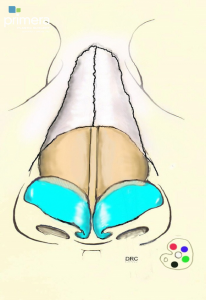
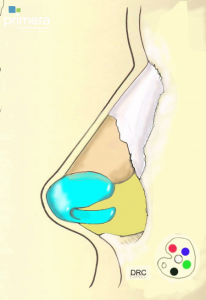
Pictured here are Gunter diagrams of the front and side views of the nose. Dr. Gross uses these templates in computer imaging consults to review the nose anatomy with each patient and then modifies them to demonstrate corrections with rhinoplasty. Education is key to a successful partnership with prospective patients and a cornerstone principle in our practice.
The lower lateral cartilages are seen in blue and comprise the nasal tip and nostrils. The beige areas are the upper lateral cartilages and comprise the middle section of the nose. The white areas are the nasal bones at the bridge area. The yellow area seen on the right is the nose septum.
“The most important attributes that you, the patient, can possess following revision nose surgery are patience and realistic expectations.”
Dr. Gross
From A Patient's Perspective
Read and hear real people discuss their unique experiences and get a perspective that is sometimes missing from shorter reviews. These stories feature some of our actual patients describing their personal journeys and what makes Primera Plastic Surgery such a special place.
What is the average rate of revision for rhinoplasty? Statistics show that revision rhinoplasty is sought in about 5 to 10% of cases, depending on the type of initial rhinoplasty performed and various other independent factors.
What is revision rhinoplasty recovery like? It may take a year or more for all the swelling to completely resolve after your surgery, and you may have some areas of scar tissue or asymmetry. These can be improved with digital compression, time, and occasional triamcinolone injections to break up any scar tissue. For a detailed timeline and recovery tips, read our revision rhinoplasty recovery guide
Can revision rhinoplasty help if my first surgery made my nose too small? “In general, it is easier to fix problems relating to under-resection, because they can be fixed by going back and taking a little more,” according to Dr. Gross. Rhinoplasty problems caused by over-resection can be a little more complicated because material needs to be added, and technical factors arising from the need to add tissue must be considered. Asymmetries can usually be improved, but with less certainty. “I find the computer imager to be essential in diagnosing and formulating a treatment strategy based on the unique anatomy encountered in each patient’s case I review,” Dr. Gross says.
If you need to use grafting material to correct or rebuild my nose, what kinds of materials are used? Various materials are used. Most commonly, cartilage is taken from inside your nose, specifically the nasal septum, (or from your ear). We also use MEDPOR® or Silastic® silicone implants. These are selected based on your unique anatomy and customized to correct the area in need. They generally stay in for life and are not anticipated to be changed out or removed. The use of FDA-approved implants has proven to be a safe and effective method of treating bridge, side-wall, or tip deficiencies in revision rhinoplasty. “Tip plasty” involves reshaping the tip of the nose.
Can I wear glasses after revision rhinoplasty? Patients who want to resume wearing glasses almost immediately after the surgery can purchase an innovative product called RhinoShield®, a flexible, silicone device that protects the cartilage.
How long will a revision rhinoplasty last? The procedure is considered permanent, although you may experience minor changes to your nose as you age.
How many times can you revise a nose job? Although there is no specific limit, each successive rhinoplasty is more complicated. If you are considering the procedure, talk about your concerns with an experienced revision rhinoplasty surgeon to determine if a revision is advisable.
How long should you wait for a revision rhinoplasty? It takes at least a year for swelling to completely dissipate and final results to be achieved. If you are dissatisfied with your results or experiencing breathing issues due to your initial procedure, a revision rhinoplasty may offer a solution in some cases.
Take the Next Step
Dr. Gross is a double board-certified facial plastic surgeon who provides individualized treatment to create balanced, natural-looking results with revision rhinoplasty. Women and men come from throughout central Florida, including Tampa, Melbourne, Jacksonville, and Daytona Beach, for Dr. Gross’ expertise in revision rhinoplasty. Request a consultation today, book online now, or call our office at
(407) 333-3040.