If you’re wondering whether JUVÉDERM or Restylane is the better filler, the short answer at Primera Med Spa is that neither is universally better. That’s not a deflection. It’s actually the most useful thing an injector can tell you, because the choice between these two hyaluronic acid fillers comes down to anatomy, treatment area, and what you’re trying to achieve.
The truth is, both are excellent go-to fillers. But they behave differently under the skin, and understanding why helps you walk into your consultation knowing the right questions to ask.
What Do JUVÉDERM and Restylane Have in Common?
JUVÉDERM and Restylane share more similarities than differences in terms of safety and effectiveness:
- Hyaluronic acid-based formulas: Both use hyaluronic acid (HA), a naturally occurring substance that attracts moisture to restore volume and smoothness.
- FDA-approved: Each has a long track record of safety and predictable results when used appropriately by an experienced injector.
- Reversible: Both can be dissolved with hyaluronidase if needed.
- Built-in comfort: Most formulations contain lidocaine to reduce discomfort during injection.
- Immediate results: You’ll see improvement right away, with continued refinement as swelling subsides.
- Similar side effects: Temporary swelling, redness, or bruising are common and typically resolve within a few days.
Ultimately, we advise Primera med spa patients that the distinction between JUVÉDERM and Restylane isn’t about safety; it’s about how each filler behaves in different areas of the face.
What’s the Real Difference Between JUVÉDERM and Restylane?
The key difference between JUVÉDERM and Restylane is how they’re built at a molecular level. This directly affects how each filler moves, holds shape, and performs in different areas of the face.
Here’s a breakdown of how they compare:
JUVÉDERM (VYCROSS® technology):
- Smooth, cohesive gel made from blended HA molecule sizes
- Flows easily through tissue and spreads evenly
- Integrates seamlessly with movement for softer transitions
- Ideal for areas where a smooth, natural, and flexible result is the goal


Restylane (NASHA® and XpresHAn Technology™):
- Slightly firmer, more structured gel
- Holds its shape and stays more precisely where placed
- Allows for controlled, targeted placement with less spread
- Ideal for areas where definition, structure, or precision is needed


The difference comes down to how each one behaves, which is why our experienced injectors often use both strategically depending on the treatment area and your goals.
How Does Treatment Area Impact Filler Selection?
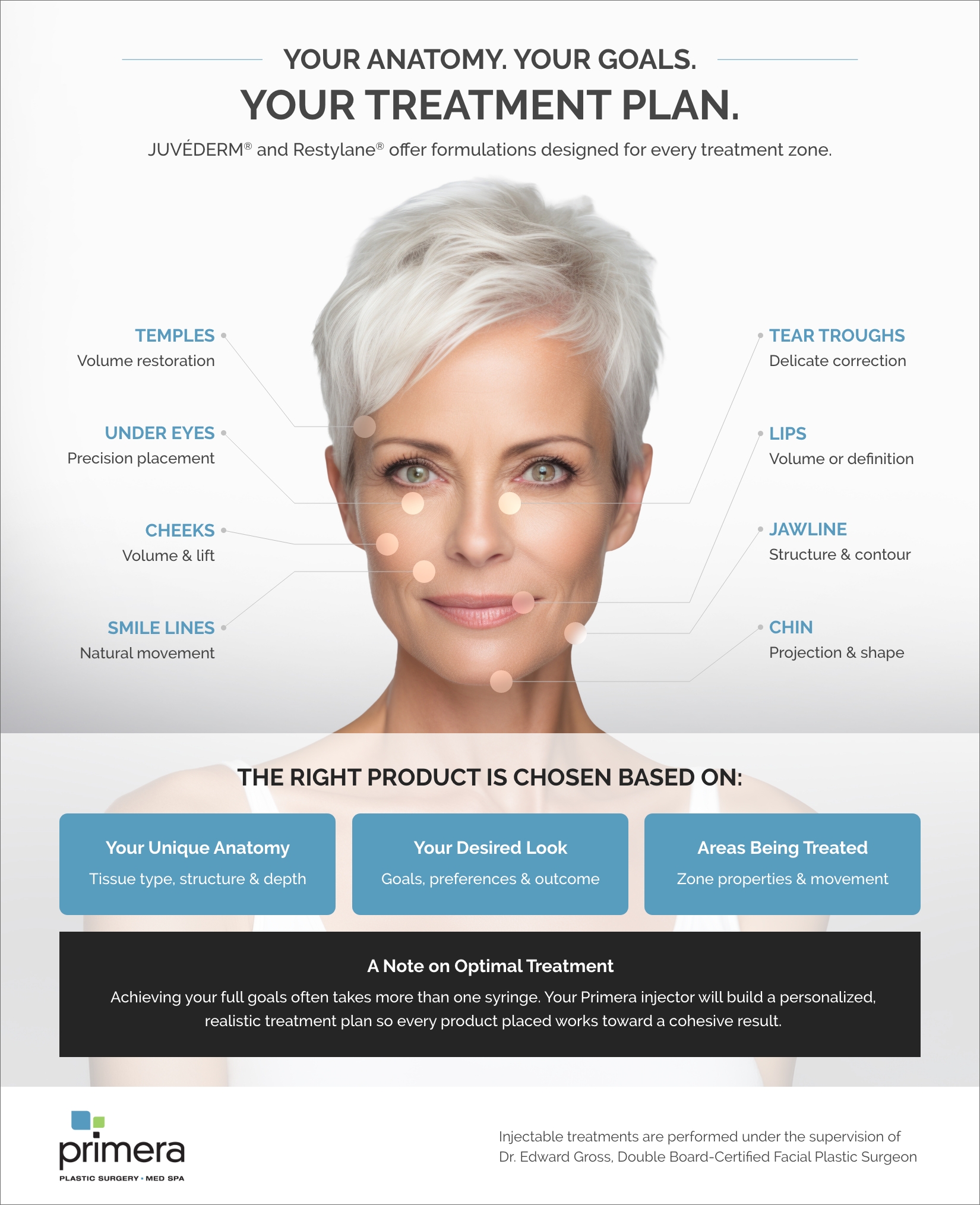
The best filler for any area isn’t about a particular brand. Instead, it’s about how a given formulation behaves with that specific tissue. Some areas benefit from a smoother, more flexible gel that integrates naturally with movement. Others call for a firmer formulation that holds its shape with greater precision. Understanding these properties is exactly what allows your injector to build a treatment plan that works for your face, not a one-size-fits-all formula.
Under Eyes and Tear Troughs
The under eye area is one of the most technically demanding places to inject because:
- The skin is thin
- The tissue is delicate
- The margin for error is narrow
In this zone, formulation behavior matters most. A firmer gel resists migration and holds precisely where placed in thin, delicate tissue. This reduces the risk of a puffy or overfilled appearance, or the bluish tint known as the Tyndall effect. A smoother, more flexible gel may be appropriate for patients needing subtle correction. Your injector will assess your anatomy and determine which formulation is best suited for treating under eye bags, dark circles, and hollows.
Restylane has precision and lower water retention, making it well-suited for delivering subtle correction without those risks. That said, JUVÉDERM VOLBELLA XC® is also an effective choice for targeting the delicate skin of tear troughs. Your injector will carefully assess your anatomy and determine which formulation is best suited for your needs.
Cheeks
For cheek augmentation and midface volume restoration, JUVÉDERM and Restylane both offer strong options, and the right choice typically depends on your anatomy and goals. Both fillers:
- Integrate naturally into the soft tissue of the cheek
- Deliver a lifted, youthful contour
- Look refreshed rather than overfilled or overdone
Restylane Lyft provides structured lift and robust volume restoration while JUVÉDERM’s smooth gel integrates naturally into soft tissue for a lifted, youthful contour. Product selection is based on your facial structure and preferred look.
Nasolabial Folds (Smile Lines)
This is one area where both fillers genuinely compete on equal footing, which is why injector preference and clinical judgment play a larger role here than anywhere else.
Specifically, JUVÉDERM VOLLURE XC and Restylane are known for:
- Providing long-lasting correction for moderate to severe nasolabial folds.
- Allowing preservation of natural facial movement (flexing with expression rather than restricting it).
- Softening smile lines (marionette lines) without creating a static or overfilled look.
Lips
If you’re debating Restylane vs JUVÉDERM for lips, both lines offer excellent options. The best choice usually comes down to aesthetic preference, such as whether you want soft volume or more defined shaping.
- JUVÉDERM for lips provides soft, natural-feeling volume and delivers a plush, hydrated look. VOLBELLA XC is excellent for subtle enhancement and fine lines, while Ultra XC delivers noticeable volume and fullness.
- Restylane for lips (Kysse) offers structure and definition, creating a sharper lip border or refined cupid’s bow. Restylane Kysse can be ideal if you prefer a more sculpted, defined pout.
Our experienced injectors will listen to your goals and guide you accordingly. For instance, if you’re inquiring about a lip flip or a gummy smile, we’ll direct you toward BOTOX® Cosmetic vs. fillers.
How Long Do JUVÉDERM and Restylane Last?
JUVÉDERM results last between 6 to 12+ months, depending on the specific product and where it’s injected. Restylane results typically last 6 to 9+ months. Longevity isn’t just a brand characteristic, though. It varies by formulation, treatment area, and how quickly your body metabolizes the filler. Areas with more movement, like the lips, break down filler faster than more stable areas like the cheeks.
The takeaway: JUVÉDERM tends to have a slight longevity edge, but it’s not universally guaranteed and shouldn’t be the primary factor in choosing one filler over the other.
How Does Primera Approach Filler Selection?
With so many injectables to choose from, our philosophy is that the right filler is the one that matches your skin tissue thickness, treatment zone, and goals.
Under the supervision of double board-certified facial plastic surgeon Dr. Edward Gross, our injectors don’t choose a filler and apply it universally. Instead, they evaluate each area of your face independently, consider how the tissue moves, and select the product or combination of products that will deliver the most natural, lasting result.
In some cases, that means using Restylane in the tear trough area and JUVÉDERM in the cheeks within the same appointment for optimal rejuvenation. It’s also worth noting that achieving your full goals may require more than one syringe. Most areas of the face benefit from adequate volume to see meaningful, lasting results, and your injector will share realistic expectations during your consultation.
JUVÉDERM vs. Restylane: Which Filler Is Right for You?
The best way to build your personalized filler treatment plan is through a private consultation at Primera Med Spa, where your injector can evaluate your facial anatomy, treatment areas, and aesthetic goals. Begin by taking our short candidacy quiz, then request a consultation by completing the online form or calling us at (407) 333-3040.
We look forward to helping you move forward with confidence and a clear plan.
Leave a Reply